

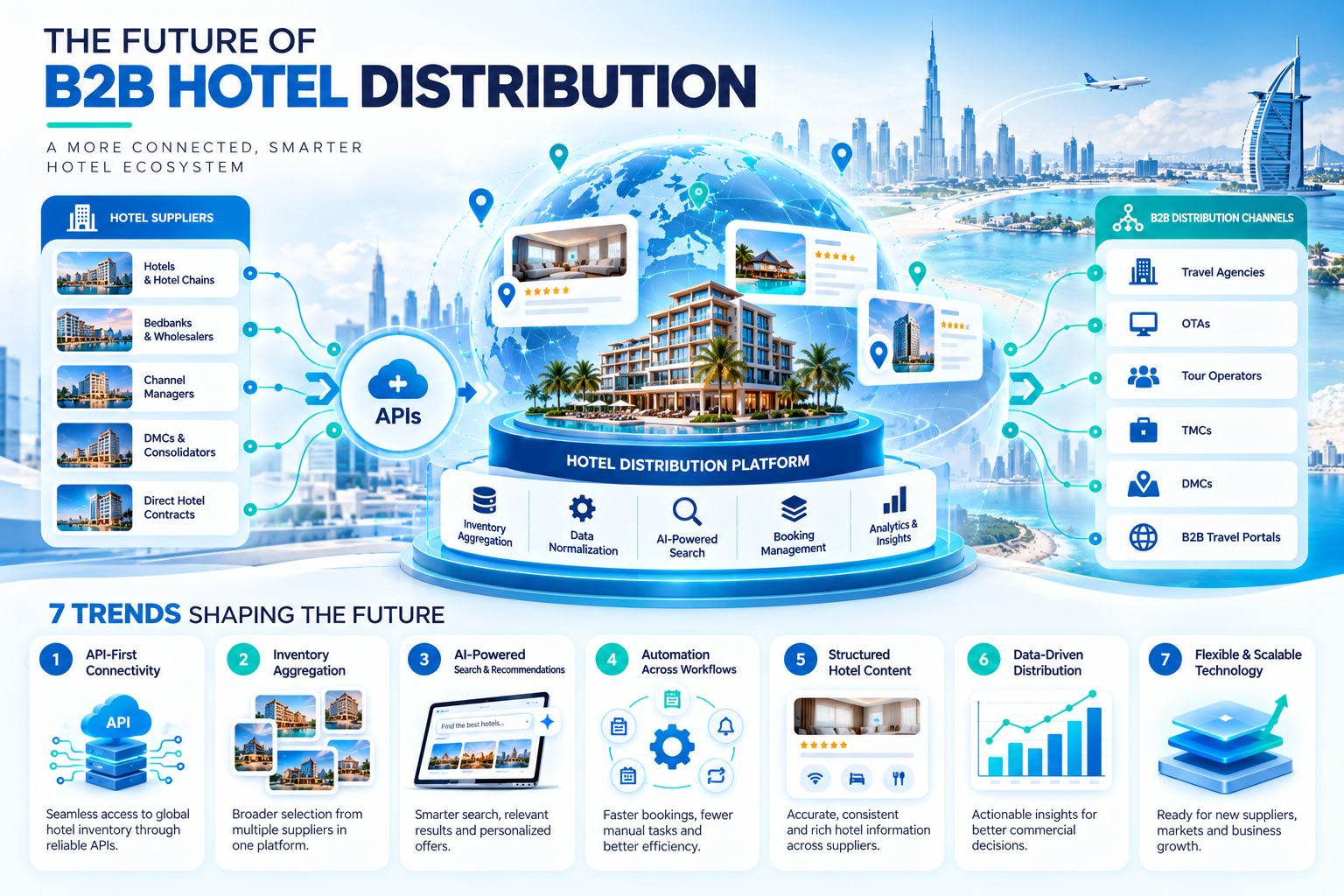
How hotel APIs, connected inventory, artificial intelligence and automation are transforming the way travel businesses source, manage and distribute hotel bookings.
The way hotels reach travelers has changed significantly. Hotel websites, online travel agencies, bedbanks, wholesalers, destination management companies and travel agencies now operate within an increasingly interconnected distribution ecosystem.
For B2B travel businesses, this creates new opportunities to expand inventory, reach new markets and improve booking efficiency. However, it also introduces complexity. Managing multiple suppliers, maintaining accurate hotel content, synchronizing rates and availability, and ensuring reliable booking workflows can become increasingly challenging as a business grows.
This is where the future of B2B hotel distribution is taking shape.
The next phase of hotel distribution is not simply about connecting more suppliers. It is about building smarter, more flexible technology that makes inventory accessible, information reliable and booking processes efficient.
Hotel APIs, inventory aggregation, artificial intelligence, automation and data-driven decision-making are becoming important parts of this evolution.
For travel agencies, online travel agencies (OTAs), bedbanks, wholesalers, tour operators and travel technology companies, understanding these changes is essential to building a competitive and scalable business.
In this guide, we explore seven trends shaping the future of B2B hotel distribution, the challenges businesses need to address, and the technology foundations that can help them prepare.
What Is B2B Hotel Distribution?
B2B hotel distribution is the process through which hotels and accommodation suppliers make their inventory available to other businesses for resale, packaging or booking.
Instead of selling exclusively to individual travelers, hotels can distribute room availability, rates and property information through intermediaries and technology platforms.
These distribution partners may include:
Bedbanks and hotel wholesalers
Online travel agencies
Travel agencies and tour operators
Destination management companies (DMCs)
Corporate travel management companies (TMCs)
B2B booking platforms
Travel consolidators and technology providers
A typical distribution ecosystem may connect hotel suppliers to wholesalers, booking platforms and downstream travel sellers through APIs, connectivity platforms or other commercial arrangements.
For example, a hotel may provide inventory to a bedbank. The bedbank distributes that inventory to a B2B booking platform, which makes it available to travel agencies. The agency can then use the platform to search for a property, compare rates and make a reservation for its customer.
This model enables hotels to reach a broader network of buyers while allowing travel businesses to access accommodation inventory without establishing a direct commercial relationship with every hotel.
However, the effectiveness of this model depends on more than supplier access. Accurate data, appropriate commercial terms, reliable integrations and consistent booking workflows are equally important.
The real value of B2B hotel distribution lies in turning supplier connectivity into inventory that businesses can confidently sell.
Why Is B2B Hotel Distribution Changing?
Travel businesses are operating in an environment where buyers expect faster service, broader product choices and increasingly seamless digital experiences.
At the same time, hotel supply is distributed across a variety of channels, providers and technology systems. Each connection can introduce different data formats, rate conditions, booking rules and operational requirements.
Several developments are influencing the future of B2B hotel distribution.
Growing demand for broader inventory
Travel sellers want access to more properties, destinations, room types and rate options. A wider selection can help them serve different customer segments and create more competitive travel packages.
However, expanding inventory also increases the complexity of managing property records, supplier relationships and booking data.
Increasing importance of connectivity
Travel businesses need efficient ways to exchange information with suppliers and distribution partners. APIs and integration platforms help automate this exchange, although the quality and scope of each connection can vary.
Pressure to improve operational efficiency
Manual hotel sourcing, repetitive data entry, booking verification and supplier communication can consume valuable time. Businesses are looking for ways to automate routine tasks while maintaining control over exceptions.
More demanding digital experiences
B2B buyers increasingly expect responsive search, clear hotel information, reliable availability and efficient reservation workflows. Slow or inconsistent systems can create friction for both travel sellers and their customers.
Greater use of data and AI
Data analytics and AI offer opportunities to improve search relevance, understand booking patterns, identify operational problems and support commercial decisions. Their effectiveness, however, depends on data quality and integration with existing business processes.
Together, these developments are moving hotel distribution toward more connected, data-driven and adaptable technology ecosystems.
7 Trends Shaping the Future of B2B Hotel Distribution
1. API-First Connectivity Will Become Increasingly Important
Hotel APIs allow travel platforms to exchange information with suppliers and distribution partners programmatically.
Depending on the provider and integration, an API may support hotel search, property information, rates, availability, reservation creation, booking retrieval, modifications and cancellations.
For a B2B travel platform, this connectivity can reduce the need for manual supplier interactions and enable hotel inventory to be incorporated into a centralized booking experience.
Consider a travel business that sources hotels from several providers. Without suitable integrations, its team may need to access multiple systems, compare offers manually and manage reservations through separate workflows.
With well-designed integrations, the platform can bring supported inventory into a common interface, apply consistent business rules and streamline booking operations.
However, connecting an API is only the beginning.
A robust hotel API integration also needs to account for:
Supplier authentication and access permissions
Request and response formats
Hotel and room mapping
Rate plans and cancellation policies
Currency and tax handling
Availability and pricing validation
Booking confirmation and error handling
Modifications, cancellations and reconciliation
Poorly managed integrations can create duplicate properties, inconsistent information and booking failures even when the underlying supplier API is functioning correctly.
What this means for travel businesses: Prioritize integration quality, monitoring and maintainability rather than measuring progress only by the number of suppliers connected.
2. Inventory Aggregation Will Create New Opportunities—and New Complexity
Inventory aggregation allows travel businesses to access accommodation options from multiple sources through a common platform or workflow.
These sources may include direct hotel connections, bedbanks, wholesalers, channel managers and other distribution partners.
The benefit is clear: a travel seller can potentially offer a broader range of accommodation options without independently building every commercial relationship.
But multiple sources can also return the same property with different names, descriptions, room categories, meal plans or cancellation conditions.
For example, one hotel may appear in three supplier systems under slightly different property names. If those records are not matched correctly, a booking platform could display duplicate listings or make comparison unnecessarily difficult.
A more effective inventory strategy combines aggregation with data normalization and supplier-level controls.
Important capabilities include:
Property and room mapping
Duplicate hotel detection
Standardized content and amenities
Consistent presentation of rate conditions
Supplier-level availability and pricing checks
Clear identification of the source of each offer
Rules for ranking or selecting comparable offers
Inventory aggregation should also consider commercial realities. A supplier offering a lower displayed rate may have different cancellation terms, payment conditions, taxes or service requirements.
The cheapest rate is not automatically the best commercial option.
What this means for travel businesses: Build an inventory strategy that balances breadth, data quality, commercial suitability and booking reliability.
3. AI Will Improve Search, Recommendations and Distribution Intelligence
Artificial intelligence is creating new ways to interpret travel preferences and work with large volumes of information.
In B2B hotel distribution, potential applications extend beyond conversational search.
AI can help travel platforms understand natural-language requests, classify hotel content, identify duplicate records, recommend properties and analyze patterns in booking behavior.
Imagine an agent searching for a family-friendly hotel in Dubai with a beach location, breakfast included and a particular budget.
A traditional search may require the agent to apply several filters and manually compare results.
An AI-assisted experience could interpret the request, identify relevant criteria and prioritize suitable properties—provided the platform has access to reliable hotel content and appropriate search capabilities.
AI may also support distribution teams by helping them:
Identify frequently searched destinations
Analyze booking and conversion patterns
Classify property descriptions and amenities
Detect unusual changes in supplier data
Identify potential cross-selling opportunities
Summarize supplier or operational performance
However, AI should not be treated as a substitute for reliable inventory and booking infrastructure.
A recommendation is only useful when the underlying property information is accurate. A suggested rate is only actionable when the price and availability can be verified. A booking workflow must still respect supplier rules, customer authorization and transaction requirements.
What this means for travel businesses: Treat AI as an intelligence layer that complements hotel APIs, booking systems and reliable data—not as a replacement for them.
4. Booking and Operational Workflows Will Become More Automated
Hotel distribution involves much more than searching for a room.
Once a traveler selects an option, the booking process may require price verification, reservation creation, supplier confirmation, payment handling, voucher generation and customer communication.
Changes and cancellations create additional work.
When these activities are managed across disconnected systems, operational teams can spend significant time checking information, updating records and following up with suppliers.
Automation can help standardize many of these processes.
For example, a booking workflow may:
Retrieve a selected hotel offer.
Recheck availability and pricing where supported.
Submit the reservation request.
Process the supplier response.
Record the booking reference and status.
Trigger the appropriate confirmation or exception workflow.
The platform must also handle cases where the supplier returns an error, a price changes, availability disappears or confirmation is delayed.
These exceptions are particularly important. A reliable system should not assume that every request results in a successful booking.
Depending on the supplier’s capabilities, automation may also assist with cancellation processing, booking modifications, reconciliation, voucher delivery and operational alerts.
What this means for travel businesses: Automate repeatable workflows while establishing clear processes for exceptions, verification and human intervention.
5. Structured Hotel Content Will Become a Competitive Advantage
Hotel inventory is not just a list of properties and rates.
Buyers need accurate information about locations, room categories, amenities, meal plans, occupancy rules, taxes, fees and cancellation conditions.
When this information is incomplete or inconsistent, it becomes harder to compare offers and recommend the right property.
For B2B platforms distributing inventory from multiple providers, structured content is particularly important.
A hotel might be described differently across supplier systems. One source may identify a room as a deluxe double, while another uses a different category name. Amenities may also be represented through inconsistent labels or data formats.
Content normalization helps bring these records into a more consistent structure.
Useful capabilities include:
Standardized hotel and room attributes
Accurate property identification
Consistent amenity categories
Clear occupancy and meal-plan information
Transparent rate and cancellation conditions
Support for multiple languages where required
Content quality checks and correction workflows
AI may assist with classification, translation and duplicate detection, but important commercial details should be validated against authoritative supplier data.
Structured hotel content also supports better search, filtering, merchandising and downstream analytics.
What this means for travel businesses: Treat hotel content as a core distribution asset, not merely descriptive text displayed on a booking page.
6. Data Analytics Will Support Better Commercial Decisions
As distribution networks grow, businesses generate information about searches, offers, bookings, cancellations, supplier performance and customer behavior.
This data can help answer important commercial questions.
Which destinations generate the most search activity? Which suppliers produce the most completed bookings? Where do users abandon the booking journey? Which properties receive frequent searches but convert poorly?
A structured analytics capability can help teams identify these patterns.
For example, high search volume combined with low booking conversion may indicate a pricing problem, weak property content, limited availability or friction in the booking journey. The data does not automatically identify the cause, but it helps teams investigate the right areas.
Useful metrics include:
Search-to-booking conversion rate
Booking completion and failure rates
Supplier response time
Availability and price-change frequency
Cancellation and modification rates
Revenue and margin by supplier or product
Booking performance by destination
Operational exception volume
Businesses should define these metrics carefully and compare like with like. Supplier response time, for example, should be measured consistently, and commercial performance should account for differences in product mix and booking conditions.
AI-powered analytics may help surface patterns and prioritize investigation, while business teams provide the context needed to interpret them.
What this means for travel businesses: Connect distribution data with commercial and operational decision-making instead of relying exclusively on booking volume or headline rates.
7. Flexible, Scalable Platforms Will Support Business Growth
A travel business may begin with a small supplier network and a straightforward booking workflow. As it expands, it may need to support more suppliers, new markets, additional currencies, different customer segments and more complex commercial rules.
A rigid platform can make each new requirement expensive and time-consuming.
A flexible architecture separates key responsibilities—such as supplier connectivity, inventory normalization, search, booking management, payments and reporting—so they can evolve without requiring the entire system to be rebuilt.
A scalable B2B hotel distribution platform should consider:
Modular integration architecture
Consistent supplier interfaces
Reusable mapping and transformation logic
Reliable booking-state management
Appropriate caching and live revalidation
Monitoring, logging and alerting
Access controls and data security
Performance under changing demand
Maintainable documentation and testing
Scalability is not just about handling more traffic. It is also about onboarding suppliers efficiently, managing complexity and adapting to new business requirements.
A platform designed for future growth should make expansion manageable without compromising booking reliability.
What this means for travel businesses: Evaluate whether your technology can accommodate future distribution needs, not only today’s requirements.
The Biggest Challenges in B2B Hotel Distribution
Although the opportunities are significant, businesses must address several persistent challenges to build an effective distribution operation.
Fragmented supplier connectivity
Different suppliers may expose different APIs, data formats, booking rules and technical capabilities. Integrating them requires careful design, testing and ongoing maintenance.
Inconsistent property and room data
Duplicate hotel records, mismatched room names and inconsistent amenities can reduce search quality and create confusion for buyers.
Pricing and availability discrepancies
Rates and availability may change between search and booking. Platforms need appropriate validation and clear handling of supplier responses.
Booking failures and uncertain status
A timeout or incomplete response does not always mean that a reservation failed. Systems need defined processes to verify booking status and avoid accidental duplicate reservations.
Operational complexity
Modifications, cancellations, refunds, reconciliation and supplier follow-ups can become difficult to manage when information is spread across multiple systems.
Limited performance visibility
Without reliable reporting, businesses may struggle to understand which suppliers, destinations or workflows are creating the greatest commercial value or operational burden.
These challenges show why successful B2B hotel distribution requires more than access to inventory. It requires an integration strategy, reliable data management and well-designed booking operations.
How Hotel APIs and Booking Technology Work Together
Hotel APIs are a key component of modern distribution, but their value depends on how they fit into the wider platform.
A typical hotel booking architecture may include the following layers.
- Supplier connectivity
Hotel APIs, bedbanks, wholesalers and other providers supply property information, rates and availability according to their supported services.
- Integration and normalization
The platform translates supplier-specific data into a consistent internal format and maps properties, room types and rate conditions.
- Search and offer management
The system presents relevant properties and offers, applies business rules and supports comparison across eligible sources.
- Booking management
When a buyer selects an offer, the platform manages price verification where supported, reservation submission, supplier responses and booking status.
- Transaction and fulfillment
The system coordinates the relevant payment, confirmation, voucher, modification and cancellation workflows.
- Monitoring and analytics
Operational tools track errors, response times, booking outcomes and commercial performance.
These layers need to work together. A fast search experience is of limited value if reservation requests fail frequently, while broad supplier access can create problems if property mapping and rate conditions are unreliable.
A well-designed platform therefore considers the entire journey—from supplier data retrieval to confirmed booking and post-booking operations.
How to Build a Future-Ready B2B Hotel Distribution Platform
Businesses planning a new platform—or upgrading an existing one—should assess their technology against a practical set of requirements.
1. Define your distribution model
Identify your target buyers, supplier relationships, commercial arrangements, markets and booking workflows.
A wholesaler distributing inventory to hundreds of travel sellers has different requirements from an agency building a hotel booking portal for its own customers.
2. Choose suppliers based on business fit
Compare inventory coverage, geographic strengths, commercial terms, content quality, technical documentation, service levels and post-booking capabilities.
Do not select a supplier solely because it claims to offer a large inventory.
3. Design integrations for maintainability
Use a consistent internal model for properties, room types, offers and reservations wherever practical. Keep supplier-specific rules manageable and ensure integrations can be monitored and updated.
4. Prioritize booking reliability
Test successful bookings as well as failures, timeouts, cancellations, price changes and uncertain supplier responses. Define how the platform verifies reservation status and prevents duplicate actions.
5. Invest in data quality
Establish processes for property mapping, duplicate detection, content validation and consistent presentation of rate conditions.
6. Plan for security and operational control
Implement appropriate authentication, access control, data protection, auditability and monitoring. Payment handling and personal data processing should follow the relevant security and regulatory requirements.
7. Measure performance from the beginning
Track search quality, booking completion, supplier response times, operational exceptions and commercial outcomes. Use these metrics to identify the next improvements.
8. Make AI adoption purposeful
Identify specific problems that AI can help solve, such as content classification, customer assistance or search relevance. Start with measurable use cases and retain suitable validation and human oversight.
9. Plan for growth
Consider future suppliers, new destinations, currencies, languages, buyer types and booking volumes. Choose an architecture that can evolve with the business.
A future-ready platform is not necessarily the one with the most features. It is the one that reliably supports the business model and can adapt as requirements change.
Choosing the Right Hotel Distribution Technology Partner
Developing and maintaining a B2B hotel distribution platform involves commercial, operational and technical decisions.
The right technology partner should understand how travel distribution works—not just how to connect an API.
Before selecting a partner, evaluate:
Travel industry experience: Can the team understand supplier connectivity, hotel inventory and booking workflows?
Integration expertise: Can it work with the relevant hotel APIs and distribution systems?
Architecture and scalability: Can the proposed solution accommodate future requirements?
Booking reliability: How will errors, timeouts, cancellations and uncertain booking status be handled?
Testing and documentation: Are integrations supported by clear documentation and structured testing?
Security and maintenance: How will access, monitoring, updates and ongoing support be managed?
Commercial transparency: Are implementation scope, dependencies, costs and responsibilities clearly defined?
A strong partnership should also include clear communication, realistic delivery expectations and a shared understanding of business objectives.
The goal is not simply to launch a platform. It is to establish technology that can support the distribution business as it grows.
How Blue7Tech Supports the Future of B2B Hotel Distribution
At Blue7Tech, we work across travel technology requirements that help businesses connect suppliers, build booking experiences and develop digital distribution capabilities.
Our relevant capabilities include hotel API integration, B2B travel solutions, customized travel portals, travel API connectivity and related technology consulting.
For businesses exploring new distribution opportunities, the right technology approach starts with understanding the business model, target buyers, supplier requirements and expected booking workflows.
From there, the platform architecture and integration strategy can be aligned with the operational and commercial objectives.
Whether a business is expanding supplier connectivity, developing a B2B booking platform or modernizing existing travel technology, the focus should remain on reliable integration, maintainable architecture and a practical path to growth.
Explore Blue7Tech to learn more about our travel technology solutions.
B2B Hotel Distribution Is Becoming a Technology Advantage
The future of B2B hotel distribution will be shaped by the way businesses connect inventory, manage data, automate workflows and turn supplier access into valuable booking experiences.
Hotel APIs will continue to play an important role. Inventory aggregation can broaden product access. AI can support search, analysis and selected workflows. Automation can reduce repetitive work, while analytics can help businesses make better commercial decisions.
But none of these capabilities works in isolation.
Reliable distribution depends on the complete system: supplier connectivity, accurate content, pricing and availability validation, booking management, operational controls and ongoing performance monitoring.
For travel agencies, OTAs, bedbanks, wholesalers, DMCs and travel technology businesses, the opportunity is to build distribution capabilities that are not only broader, but also more reliable and adaptable.
The future of B2B hotel distribution isn’t just about reaching more buyers. It’s about making hotel inventory more connected, reliable and ready to sell.
Ready to strengthen your hotel distribution technology?
If you’re planning to expand hotel connectivity, build a B2B booking platform or modernize your travel technology infrastructure, Blue7Tech can help you explore an approach aligned with your business requirements.
Connect with Blue7Tech to discuss your hotel distribution technology needs.
