

When a “Booking Error” Is More Than an Error
For a traveler, a booking error might look like a simple message:
“Sorry, something went wrong.”
For a travel technology team, it can mean something much more serious.
A fare may have changed between search and booking. A hotel room may no longer be available. A supplier may return an unexpected response. A payment may succeed while the booking remains unconfirmed. Two suppliers may return the same property using different identifiers.
And when these events aren’t handled correctly, the consequences can extend far beyond one failed transaction.
They can lead to:
Customer complaints
Refund requests
Support tickets
Lost bookings
Revenue leakage
Manual reconciliation
Supplier disputes
Damage to customer trust
This is why travel API integration should not be treated as simply connecting an API and displaying its response.
The real engineering challenge is creating a reliable layer between multiple external travel systems and the booking experience your customers see.
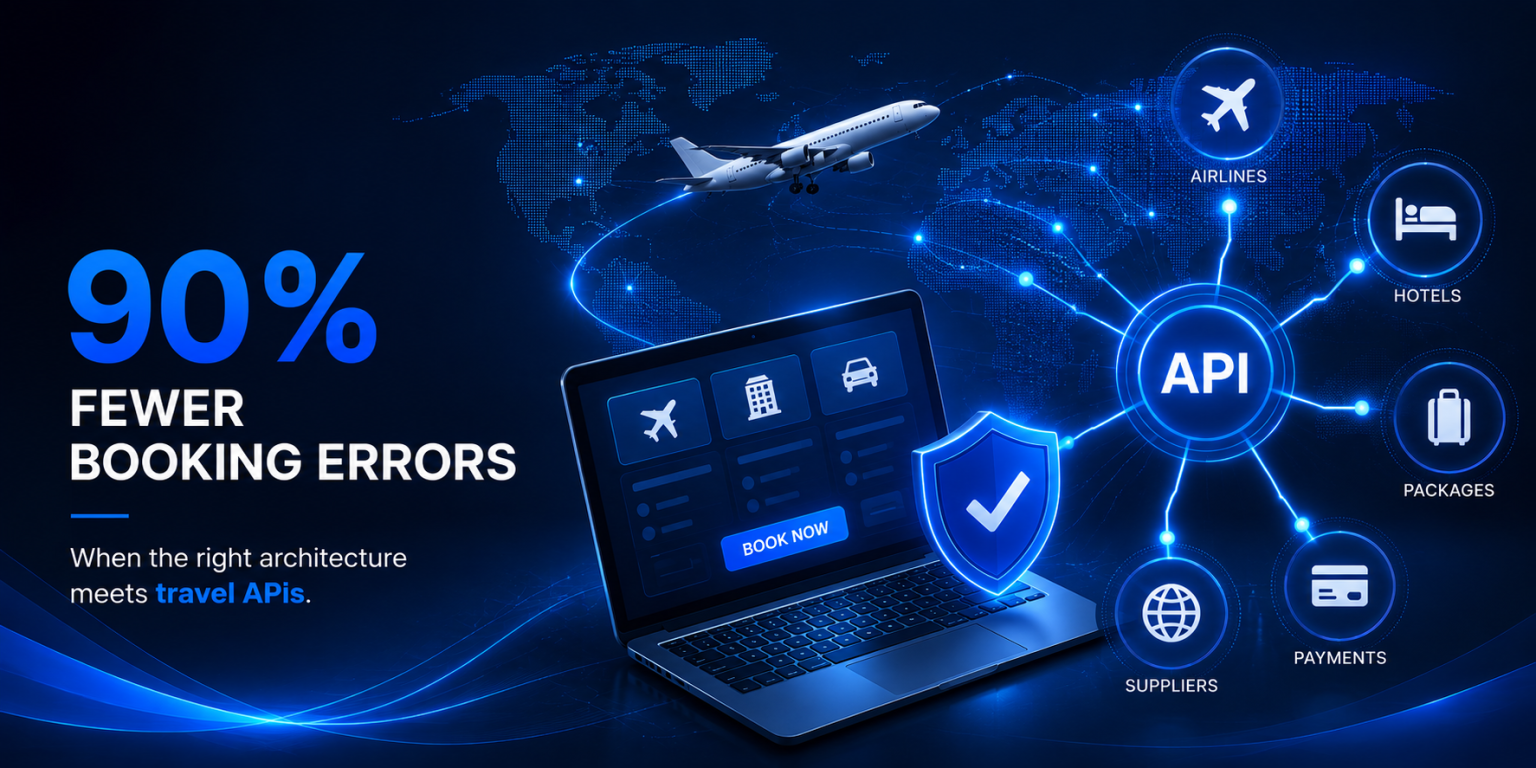
In this case-based exploration, we look at how a well-engineered travel API integration architecture can dramatically reduce booking errors—and, where supported by measured project data, deliver error reductions of up to 90%.
The Real Source of Booking Errors in Travel Platforms
A modern travel platform rarely depends on a single data source.
An OTA or travel business may connect to:
Airline APIs
NDC APIs
GDS platforms
Hotel APIs
Bed banks
Transfer providers
Payment gateways
Insurance providers
Other travel suppliers
Each external system has its own:
Data structures
Authentication methods
Business rules
Error codes
Response times
Availability models
Pricing logic
Cancellation rules
The result is a highly distributed booking environment.
A customer sees one booking interface.
Behind that interface, however, multiple systems may be communicating simultaneously.
A simplified flow looks like this:
Customer
↓
Travel Platform
↓
API / Integration Layer
↓
Multiple Travel Suppliers
↓
Availability + Pricing
↓
Booking
↓
Payment
↓
Confirmation
Every additional dependency creates another potential failure point.
That doesn’t mean APIs are the problem.
It means the architecture connecting them matters.
Why Connecting an API Isn't Enough
A common misconception is:
“Once the supplier API is connected, the integration is complete.”
In production travel technology, that is only the beginning.
Consider a hotel booking.
A customer searches for a room and sees:
Deluxe Room — AED 850
The customer selects the room and proceeds to checkout.
A few seconds later, the supplier returns:
Price changed — AED 930
If the platform simply assumes the original search result is still valid, it could create an inconsistent booking experience.
A robust architecture should instead:
Retrieve availability.
Display the offer.
Revalidate availability before booking.
Revalidate price.
Confirm booking conditions.
Process the transaction.
Record the supplier response.
Reconcile booking and payment status.
This additional validation layer is one of the ways a travel platform can prevent avoidable booking failures.
The Case: Turning an Error-Prone Booking Flow Into a Reliable One
Imagine a travel platform experiencing frequent booking issues.
The platform connects customers to multiple travel suppliers.
Its booking flow works—but not consistently.
Some customers encounter:
Price mismatches
Availability failures
Supplier timeouts
Duplicate requests
Incomplete booking responses
Payment/booking status mismatches
The technology team initially sees these as individual API issues.
But a deeper analysis reveals a larger architectural problem:
The platform is exposing supplier complexity directly to the booking workflow.
The solution isn’t necessarily to replace every supplier.
The solution is to introduce a stronger integration architecture between the platform and its external providers.
The Solution: A Resilient Travel API Integration Layer
A robust integration layer acts as a control point between the travel platform and external suppliers.
Instead of allowing every supplier to communicate differently with the core booking system, the integration layer translates, validates, monitors, and manages those interactions.
Architecture
Customer Interface
↓
Booking Platform
↓
API Gateway
↓
Travel Integration Layer
↙ ↓ ↘
Airlines | Hotels | GDS/NDC | Other Suppliers
↓
Normalized Data
↓
Booking & Payment Services
This separation allows the core platform to work with a consistent internal model even when suppliers use different formats and processes.
Data normalization is particularly important because travel suppliers can represent properties, rates, reservations, and other information differently.
1. Data Normalization: One Internal Language
One of the biggest challenges in multi-supplier travel technology is inconsistent data.
For example:
Supplier A might return:
propertyName
Supplier B:
hotel_name
Supplier C:
property_title
The customer doesn’t care which supplier provided the data.
They need to see:
Hotel Name
A normalization layer converts different supplier responses into a consistent internal structure.
The same approach can be applied to:
Hotel names
Room types
Amenities
Cancellation policies
Taxes
Currency
Passenger information
Fare rules
Booking status
This prevents supplier-specific data structures from spreading throughout the core application.
Why this matters
Without normalization:
Supplier → Front End
With normalization:
Supplier → Adapter → Normalization → Core Platform → Front End
The second model is much easier to maintain as the number of integrations grows.
2. Pre-Booking Validation
One of the most effective ways to reduce booking errors is to validate critical information before committing the transaction.
Before booking, the platform can verify:
Availability
Current price
Passenger information
Room configuration
Fare conditions
Cancellation policy
Supplier status
This is particularly important for travel products where inventory and prices can change rapidly.
The objective is simple:
Don’t book what you haven’t validated.
3. Intelligent Error Handling
Not every API error means the same thing.
A supplier timeout is different from:
Invalid passenger information
Expired fare
Sold-out inventory
Authentication failure
Rate-limit response
Temporary supplier outage
Treating every error as:
“Booking failed”
creates a poor customer experience and makes troubleshooting harder.
A mature travel API integration layer should classify errors and determine the appropriate response.
For example:
Temporary failure
Retry where appropriate.
Expired availability
Recheck inventory and present updated options.
Invalid customer information
Ask the user to correct the information.
Supplier outage
Use an alternative provider where the architecture supports it.
Payment succeeded but booking failed
Trigger reconciliation and appropriate recovery workflows.
4. Idempotency: Preventing Duplicate Bookings
Imagine a customer clicks Book Now.
The request reaches the server.
The supplier takes a few seconds to respond.
The customer doesn’t see a response and clicks again.
Without appropriate safeguards, the platform could potentially send two booking requests.
This is where idempotency becomes important.
The system can assign a unique transaction or booking request identifier and ensure that repeated requests don’t unintentionally create duplicate transactions.
For CTOs, this is a critical distinction:
Reliable booking systems don’t assume users will behave perfectly.
They are designed to handle retries, duplicate requests, delayed responses, and uncertain states.
5. Retry Logic That Understands Context
Retries can improve resilience—but blindly retrying every failed API request can make things worse.
Consider:
Timeout → Retry
That may be reasonable for certain temporary failures.
But:
Invalid passenger data → Retry
doesn’t solve anything.
A strong integration layer therefore uses error-aware retry policies.
For example:
Error Type | Possible Action |
Temporary timeout | Controlled retry |
Rate limit | Backoff |
Invalid request | Stop + validate |
Expired price | Revalidate |
Supplier unavailable | Fallback |
Duplicate request | Idempotency check |
The exact policy should depend on the supplier contract and API behavior.
6. Payment and Booking Reconciliation
This is one of the most important parts of the architecture.
Consider this scenario:
Payment = Successful
but
Booking = Unknown
What happens next?
A weak system may immediately show:
Booking Failed
and initiate a manual support process.
A stronger architecture creates an intermediate state and performs reconciliation.
The system can:
Record the payment transaction.
Record the supplier booking request.
Monitor the supplier response.
Query booking status where supported.
Reconcile payment and booking states.
Trigger the appropriate confirmation or refund workflow.
This protects both the customer and the business.
7. Supplier-Specific Adapters
Different travel suppliers have different requirements.
Instead of putting supplier-specific logic into the core booking engine, create dedicated adapters.
Example
Core Booking Service
↓
Supplier Adapter
↙ ↓ ↘
Hotel API A | Hotel API B | Hotel API C
Each adapter handles supplier-specific:
Authentication
Request formats
Response mapping
Error codes
Rate limits
Booking rules
This approach means adding another supplier doesn’t require rewriting the entire booking engine.
Modern travel booking architectures commonly use an integration layer to isolate supplier-specific formats and rules from the rest of the platform.
8. Monitoring: You Can't Improve What You Can't Measure
Reducing booking errors requires visibility into where those errors occur.
A CTO should be able to answer:
Which supplier has the highest failure rate?
Which endpoint is timing out?
At which step are bookings failing?
How often do prices change between search and booking?
How many payments are successful without confirmed bookings?
Which errors are increasing?
What is the average supplier response time?
Useful metrics include:
API Performance
Response time
Timeout rate
Error rate
Availability
Booking Performance
Search-to-book conversion
Booking failure rate
Cancellation rate
Rebooking rate
Payment Performance
Payment success rate
Payment/booking mismatch
Refund volume
Supplier Performance
Supplier error rate
Inventory response rate
Price change frequency
These metrics turn API integration from a technical black box into an observable business system.
Where the 90% Improvement Comes From
The important point is this:
Travel API integration does not magically reduce booking errors by 90%.
The improvement comes from what is built around the APIs.
A reduction of up to 90% may be achievable in a specific implementation when a platform addresses the underlying causes of errors through measures such as:
Data normalization
Pre-booking validation
Supplier-specific error handling
Idempotency
Intelligent retries
Payment reconciliation
Monitoring
The percentage should only be published as a Blue7 case-study metric if it has been measured against a defined baseline and time period.
Before vs. After
Before | After |
Supplier-specific responses | Normalized data |
Generic error handling | Error classification |
Blind retries | Controlled retries |
Repeated booking requests | Idempotency |
Stale availability | Pre-booking validation |
Payment/booking ambiguity | Reconciliation |
Limited visibility | Real-time monitoring |
Manual troubleshooting | Structured observability |
The goal isn’t simply to make the API connection work.
The goal is to make the entire booking system resilient to failure.
Why This Matters to CTOs
For a CTO, booking errors aren’t just a development problem.
They affect:
Engineering
More incidents and technical debt.
Operations
More manual intervention.
Finance
More refunds and reconciliation.
Customer Experience
More complaints and lost trust.
Revenue
More failed transactions and abandoned bookings.
This is why travel API architecture should be treated as a strategic technology decision rather than an integration task.
A Practical Architecture for Reliable Travel API Integration
A scalable architecture can be structured into several layers:
Layer 1 — Experience
Web and mobile applications.
Layer 2 — API Gateway
Authentication, routing, throttling and access control.
Layer 3 — Booking Services
Search, availability, pricing, booking and cancellation.
Layer 4 — Integration Layer
Supplier adapters and API orchestration.
Layer 5 — Data Normalization
Converts supplier-specific responses into consistent internal models.
Layer 6 — Resilience
Retries, timeouts, circuit breakers and fallback strategies.
Layer 7 — Transaction Management
Payments, booking state and reconciliation.
Layer 8 — Observability
Logs, metrics, tracing, alerts and dashboards.
This separation makes it easier to add suppliers and evolve the platform without introducing supplier-specific complexity into every part of the system.
What CTOs Should Ask Before Choosing a Travel API Integration Partner
Don’t ask only:
“Can you integrate this API?”
Ask:
How will supplier data be normalized?
How will price and availability be revalidated?
How are supplier failures handled?
What happens if payment succeeds but booking confirmation fails?
How are duplicate booking requests prevented?
Can suppliers be added without changing the core booking engine?
How are API performance and errors monitored?
How will the architecture scale as booking volume increases?
How will API changes and supplier upgrades be managed?
These questions reveal whether you’re evaluating an API developer—or a travel technology engineering partner.
How Blue7 Technologies Approaches Travel API Integration
For travel businesses, API connectivity is only one part of the technology challenge.
The larger objective is to create a reliable digital ecosystem where suppliers, booking workflows, payments, inventory, and customer experiences work together.
Blue7 Technologies focuses on travel technology solutions designed around the operational realities of travel businesses.
Depending on the platform requirements, this can include:
Travel API integration
Hotel API integration
Flight API integration
NDC API integration
Booking engine development
B2B travel platforms
Supplier connectivity
Travel automation
Custom travel software
Travel platform development
The focus should remain on the complete booking workflow—not simply on establishing a connection to a supplier.
When a “Booking Error” Is More Than an Error
A travel API is a connection.
A reliable travel platform is an architecture.
The difference is significant.
When APIs are connected without a resilient integration layer, supplier inconsistencies, stale data, timeouts, duplicate requests, and booking/payment mismatches can become recurring operational problems.
When those integrations are surrounded by:
Data normalization
Validation
Idempotency
Intelligent retries
Error classification
Reconciliation
Monitoring
Supplier abstraction
the platform becomes much more resilient.
And that is where meaningful improvements in booking reliability can come from.
For CTOs building or scaling travel platforms, the question shouldn’t be:
“How many APIs can we connect?”
It should be:
“How reliably can our platform turn those API connections into successful bookings?”
That is the real measure of effective travel API integration.
Connect APIs. Reduce Errors. Scale Bookings.
Your APIs should do more than connect suppliers.
They should power reliable, scalable booking experiences.
Build a travel platform engineered for fewer errors, faster bookings, and seamless integrations.
Talk to Our Travel Technology Experts →
