Building a Scalable OTA: The Essential Technology Stack for Travel Startups
Posted By
Bijesh
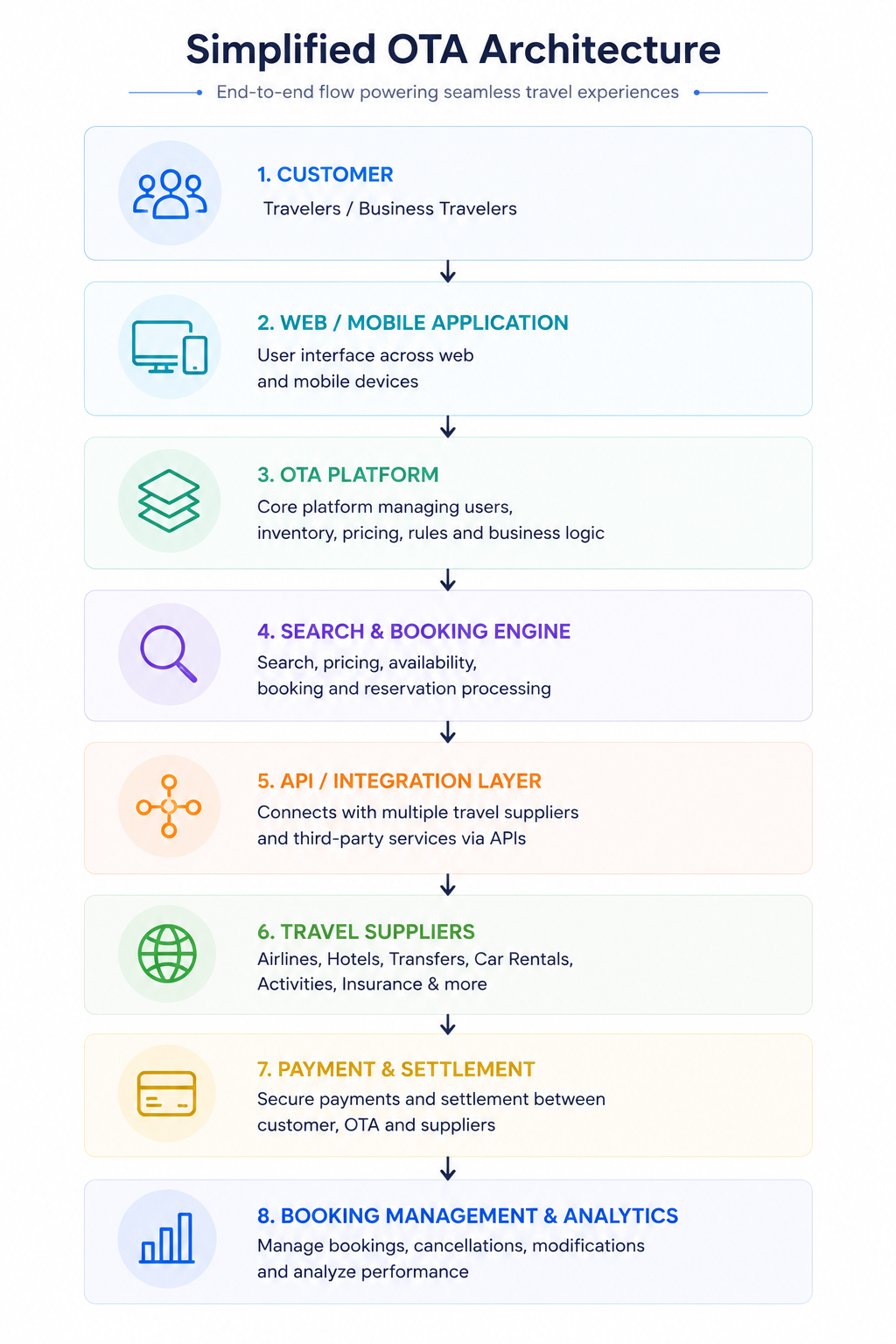
Launching an Online Travel Agency (OTA) is easier than ever from a business-model perspective. Building one that can scale reliably, integrate global travel inventory, process thousands of bookings, and deliver a seamless customer experience is a very different challenge.
A successful OTA is much more than a website where customers search for flights or hotels.
Behind every search result and booking confirmation is a technology ecosystem connecting customers, suppliers, APIs, payment gateways, booking engines, databases, analytics systems, and operational teams.
For travel startups, choosing the right technology architecture from the beginning can make the difference between a platform that scales smoothly and one that becomes increasingly difficult and expensive to maintain.
The good news is that startups don’t need to build every component from scratch.
With the right OTA software, travel APIs, cloud infrastructure, and technology architecture, startups can build a flexible travel platform that supports their immediate business requirements while remaining ready for future growth.
This guide explains the essential technology stack behind a scalable OTA and the key technical considerations startups should make before building their platform.
What Is an OTA Technology Platform?
An Online Travel Agency technology platform is the software infrastructure that enables a business to search, compare, sell, and manage travel products digitally.
Depending on the business model, an OTA may offer:
Flights
Hotels
Holiday packages
Transfers
Car rentals
Activities
Travel insurance
Ancillary services
The platform connects the customer-facing experience with suppliers and third-party providers through APIs and other integrations.
The technology stack supporting these layers needs to be designed for performance, scalability, security, and flexibility.
Why Technology Architecture Matters for Travel Startups
For an early-stage startup, it can be tempting to focus entirely on the front end.
After all, customers interact with the website or app—not the underlying infrastructure.
But the customer experience is directly influenced by what happens behind the scenes.
A slow API can result in a slow search.
An unreliable supplier connection can result in unavailable inventory.
Poor booking architecture can cause duplicate or failed reservations.
A weak payment architecture can create transaction failures.
And an inflexible database can become a bottleneck as the business grows.
That’s why an OTA should be designed as a complete technology ecosystem rather than simply a booking website.
Essential Technology Stack for a Scalable OTA
1. Customer-Facing Web and Mobile Applications
Let’s break the architecture into its major components.
The front end is where customers search, compare, select, and book travel products.
A modern OTA should provide a fast, intuitive, and responsive experience across devices.
Essential capabilities include:
Destination and product search
Filters and sorting
Real-time availability
Pricing display
Product comparison
Customer accounts
Booking management
Secure checkout
Notifications
Mobile responsiveness
For startups, the priority should not be building the largest interface possible.
Instead, focus on creating a fast, simple booking journey.
A customer should be able to move from:
Search → Compare → Select → Pay → Confirm
with minimal friction.
2. OTA Booking Engine
The booking engine is one of the most important components of OTA software.
It manages the core booking workflow between the customer, the OTA, and the travel supplier.
For example:
Customer searches
↓
Platform requests inventory
↓
Supplier APIs return results
↓
OTA normalizes and displays results
↓
Customer selects product
↓
Price and availability are revalidated
↓
Payment is processed
↓
Booking is confirmed
↓
Confirmation is delivered
A scalable booking engine should be capable of handling high volumes of concurrent searches and bookings without compromising reliability.
Important booking engine capabilities
Search management
Availability checking
Price validation
Booking creation
Cancellation
Modification
Refund management
Voucher generation
Booking status tracking
Supplier confirmation
This is where investing in robust OTA software becomes particularly important.
3. Travel API Integration Layer
Travel APIs connect the OTA with external travel suppliers.
Instead of manually maintaining inventory, the platform can retrieve information from connected providers.
Depending on the business model, integrations may include:
Hotel APIs
Flight APIs
NDC APIs
GDS systems
Car rental APIs
Transfer APIs
Activity APIs
Insurance APIs
Payment APIs
The API layer should ideally be designed separately from the front-end application.
Why?
Because suppliers change.
A startup may initially work with a few hotel or flight providers and later add many more.
A flexible integration architecture allows new suppliers to be added without rebuilding the entire platform.
4. API Aggregation and Data Normalization
This is one of the most important—and often overlooked—parts of an OTA architecture.
Different suppliers may return information in different formats.
One provider might call a field hotelName, while another uses property_name.
Room types, cancellation policies, currencies, meal plans, and pricing structures can also vary.
An OTA therefore needs a normalization layer.
Example
Supplier A:
hotelName
Supplier B:
propertyName
Supplier C:
property_title
The OTA platform can normalize these into:
Property Name
The same principle applies to:
Room types
Amenities
Locations
Fare rules
Cancellation policies
Passenger information
Currency
Taxes
Markups
A strong normalization layer makes the rest of the platform significantly easier to maintain.
5. Hotel and Flight Inventory Management
Inventory is at the heart of an OTA.
A travel platform needs to understand what is available, at what price, under which conditions, and from which supplier.
Hotel inventory may include:
Property information
Room availability
Room types
Rates
Meal plans
Cancellation policies
Taxes
Promotions
Flight inventory may include:
Routes
Schedules
Fare classes
Baggage allowances
Seat availability
Fare rules
Ancillaries
The architecture should support real-time or near-real-time updates wherever required.
This helps reduce problems such as:
Stale availability
Incorrect pricing
Failed bookings
Customer dissatisfaction
6. Search and Recommendation Technology
Search is one of the most technically demanding parts of an OTA.
A customer may search for:
Dubai → London
for multiple dates, passengers, cabin classes, and preferences.
The platform may need to query multiple suppliers and process hundreds or thousands of results.
A scalable search architecture should consider:
Search speed
Caching
Result aggregation
Filtering
Sorting
Deduplication
Ranking
Personalization
For larger platforms, technologies such as dedicated search engines and distributed caching can help improve response times.
For startups, this becomes particularly important as booking volumes increase.
10. Customer Account and CRM Layer
Customer data can become one of an OTA’s most valuable assets.
A CRM layer can help businesses understand:
Who their customers are
What they book
Where they travel
How frequently they book
What products they prefer
How much they spend
This information can support:
Personalized offers
Loyalty programs
Retargeting
Customer support
Marketing automation
The goal isn’t simply to collect customer data.
It is to turn that data into a better customer experience.
11. Notification and Communication System
Travel bookings generate many important events.
For example:
Booking Confirmed
Payment Successful
Booking Cancelled
Flight Changed
Refund Processed
An OTA should have a centralized communication layer capable of delivering notifications through relevant channels.
These may include:
Email
SMS
Push notifications
WhatsApp or other messaging channels
A centralized notification service also makes it easier to maintain consistent customer communication across the platform.
12. Database Architecture
The database is the foundation of the platform’s data layer.
An OTA may need to manage:
Customer profiles
Bookings
Payments
Supplier information
Products
Pricing
Transactions
Reviews
Analytics data
A common approach is to use relational databases for transactional data while introducing specialized data stores where required for search, caching, analytics, or high-volume workloads.
The architecture should prioritize:
Data integrity
Availability
Backup
Recovery
Performance
Scalability
Avoid choosing a database simply because it is popular.
Choose based on the specific workload of your OTA.
13. Cloud Infrastructure
Cloud infrastructure gives travel startups the flexibility to scale resources as demand changes.
This is particularly useful because travel demand isn’t always predictable.
Search and booking traffic may increase significantly during:
Holiday seasons
Major events
Promotional campaigns
Destination peaks
Flash sales
A cloud-based architecture can support:
Auto-scaling
Load balancing
High availability
Backup and recovery
Monitoring
Distributed infrastructure
For startups, cloud infrastructure can also reduce the need for large upfront investments in physical infrastructure.
14. Security and Data Protection
An OTA handles sensitive information.
This can include:
Personal information
Passport details
Payment information
Travel itineraries
Customer accounts
Security therefore needs to be built into the architecture.
Key considerations include:
Encryption
Secure authentication
Role-based access control
API security
Data protection
Vulnerability monitoring
Secure payment processing
Audit logging
Security shouldn’t be treated as a final-stage feature.
It should be part of the platform architecture from day one.
15. Monitoring and Observability
A scalable OTA needs visibility into what’s happening across the platform.
Imagine customers suddenly report that hotel searches are failing.
Without proper monitoring, the technology team may spend hours trying to determine whether the issue is related to:
The front end
The booking engine
A supplier API
The database
Network connectivity
Payment infrastructure
Observability tools can provide visibility into:
Application performance
API response times
Error rates
Infrastructure health
Booking failures
Traffic patterns
This allows technical teams to detect and resolve problems faster.
16. Analytics and Business Intelligence
Technical infrastructure isn’t enough.
An OTA also needs to understand how the business is performing.
Useful metrics include:
Acquisition
Website traffic
Customer acquisition cost
Conversion rate
Booking
Search-to-booking ratio
Booking volume
Average booking value
Cancellation rate
Revenue
Gross booking value
Commission
Markup
Revenue per customer
Product
Top destinations
Best-selling hotels
Popular flight routes
Supplier performance
Analytics helps founders make decisions based on data rather than assumptions.
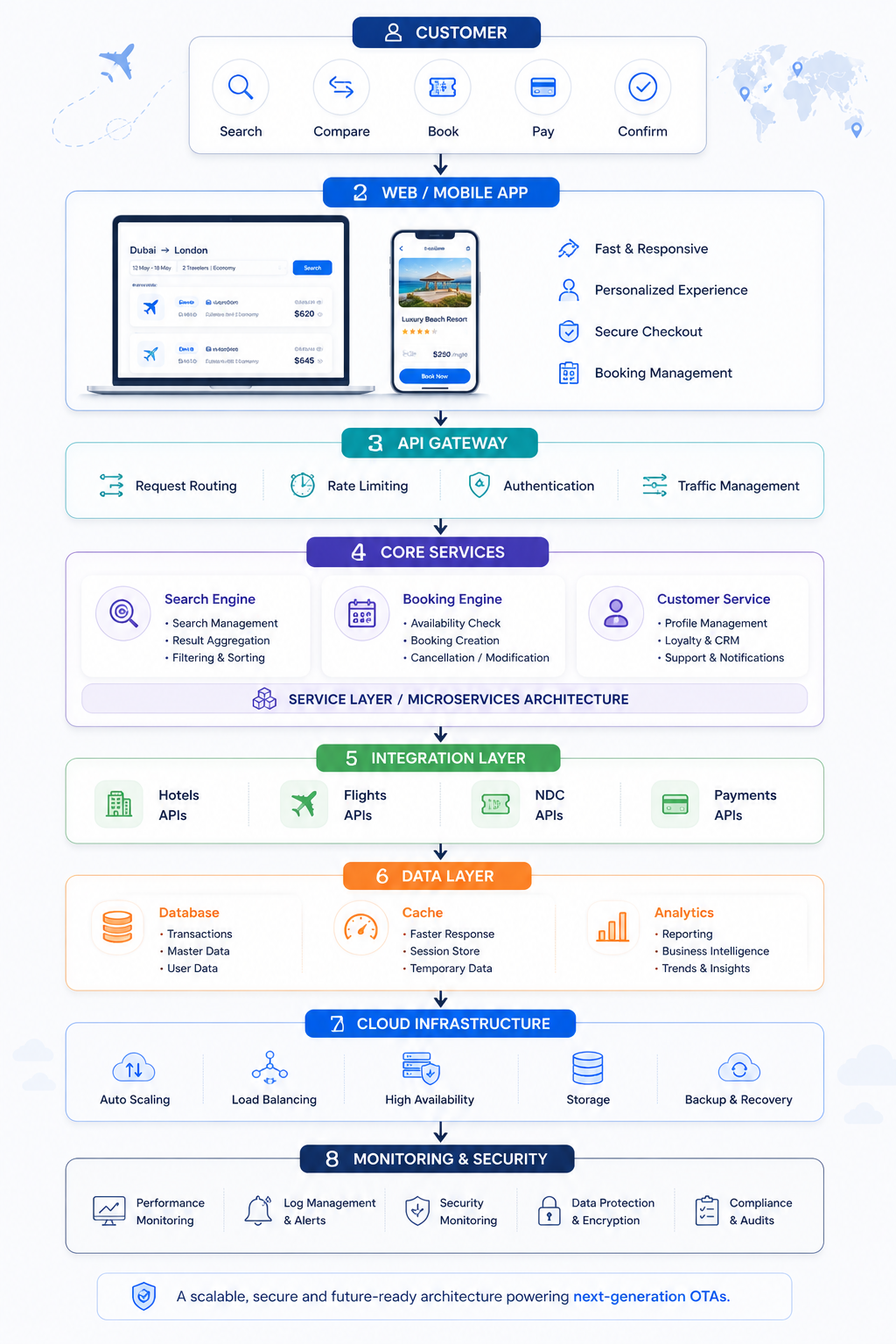
A Reference Architecture for a Scalable OTA
The actual architecture will vary depending on the OTA’s business model, product scope, geography, supplier ecosystem, and expected transaction volume.
Should a Travel Startup Build or Buy OTA Software?
This is one of the most important decisions for an early-stage OTA.
There are generally three approaches.
Build Everything From Scratch
Advantages:
Maximum control
Complete customization
Full ownership of architecture
Challenges:
Higher development costs
Longer time to market
Greater technical complexity
Requires an experienced engineering team
Use an Existing OTA Platform
Advantages:
Faster launch
Proven functionality
Lower initial development effort
Existing travel integrations
Challenges:
Customization limitations may exist
Dependence on platform provider
Integration requirements still need consideration
Build a Hybrid Platform
For many startups, a hybrid approach can be practical.
Use established technology for foundational capabilities while building differentiated functionality internally.
For example:
Use existing technology for:
Travel APIs
Payment gateways
Cloud infrastructure
Authentication
Build internally:
Customer experience
Pricing strategy
Recommendation engine
Loyalty features
Business-specific workflows
The right choice depends on the startup’s budget, timeline, technical expertise, and competitive strategy.
MVP vs Scalable OTA: What Should You Build First?
Startups often make the mistake of trying to build everything at once.
A better approach is to define a focused MVP.
Phase 1: MVP
Focus on:
Customer registration
Search
Supplier integration
Booking
Payment
Confirmation
Basic administration
Basic analytics
Phase 2: Growth
Add:
Multiple suppliers
Advanced pricing
Loyalty
CRM
Promotions
Advanced reporting
Mobile applications
Additional travel products
Phase 3: Scale
Introduce:
Advanced personalization
AI-powered recommendations
Automated operations
Advanced analytics
Multi-market support
More supplier connectivity
Enterprise integrations
This phased approach lets startups validate the business model before investing heavily in advanced technology.
Common Technology Mistakes OTA Startups Should Avoid
1. Building a Monolithic Platform Too Early
A tightly coupled architecture can make future changes difficult.
2. Ignoring Supplier Failures
Third-party APIs can fail or return unexpected responses. The platform needs appropriate fallback and error-handling strategies.
3. Treating Search and Booking as the Same Problem
Search requires speed and aggregation. Booking requires accuracy, validation, and transactional integrity.
4. Hard-Coding Business Rules
Pricing, commissions, and supplier rules will change. These should be configurable wherever possible.
5. Underestimating Data Quality
Poor hotel mapping, duplicate properties, inconsistent room names, and incorrect content can damage customer trust.
6. Building Without Scalability in Mind
A platform that works for 100 bookings may not work the same way at 100,000 bookings.
7. Ignoring Observability
You can’t improve what you can’t monitor.
How Blue7 Technologies Can Help Travel Startups Build Scalable Platforms
Building an OTA requires expertise across travel technology, API connectivity, booking workflows, integrations, and scalable platform development.
Blue7 Technologies works in the travel technology space, helping businesses develop digital solutions around travel booking and distribution.
For a startup, the right technology partner can help translate a business concept into a functioning travel platform while reducing the complexity associated with building every component independently.
Depending on the business requirements, an OTA technology solution can incorporate capabilities such as:
B2B and B2C booking platforms
Travel API integrations
Hotel and flight connectivity
Booking engine development
Supplier connectivity
Inventory management
Payment integration
Travel automation
Business intelligence
Custom travel software
The objective isn’t simply to launch another booking website.
It’s to create a technology foundation that can adapt as the startup grows.
How Blue7 Technologies Can Help Travel Startups Build Scalable Platforms
Before choosing a technology provider, startups should ask:
Does the provider understand travel?
Travel technology has unique challenges that generic software development companies may not fully understand.
Can the platform integrate with multiple suppliers?
Supplier connectivity is fundamental to an OTA.
Is the architecture scalable?
Ask how the platform handles increasing search and booking volumes.
Can the platform be customized?
Your technology should support your business model rather than forcing your business into a rigid workflow.
Is post-launch support available?
Launching the platform is only the beginning.
Can new products be added later?
Your startup may begin with hotels and eventually add flights, transfers, activities, or other services.
The Future of OTA Technology
The OTA technology landscape is evolving quickly.
Several technologies are expected to influence the next generation of travel platforms.
Artificial Intelligence
AI can support:
Personalized recommendations
Conversational travel search
Customer service
Demand forecasting
Dynamic pricing
Fraud detection
NDC and Modern Airline Distribution
NDC is changing how airline content and offers can be distributed through travel technology ecosystems.
For OTAs, modern airline connectivity can create opportunities to access richer content and ancillary services.
Hyper-Personalization
Travel platforms are moving beyond generic search results toward experiences based on individual customer preferences and behavior.
Automation
From booking operations to customer communication, automation can reduce manual effort and improve response times.
Data-Driven Travel Commerce
As platforms collect more behavioral and transaction data, analytics will become increasingly important for understanding customer demand and optimizing revenue.
Final Checklist: Is Your OTA Ready to Scale?
Before launching, make sure your platform can answer “yes” to the following:
Is the booking engine reliable?
Can you integrate multiple travel suppliers?
Is supplier data normalized?
Can pricing and commissions be configured?
Is payment processing secure?
Can bookings be modified and cancelled?
Is customer data protected?
Can infrastructure scale with demand?
Are API failures handled properly?
Do you have monitoring and alerts?
Can you analyze booking and revenue data?
Can you add new travel products later?
Is post-launch technical support available?
If the answer to most of these is yes, you’re building more than an OTA website—you are building a scalable travel technology platform.
Building an OTA is not simply a matter of developing a website, connecting a hotel API, and adding a payment button.
A scalable OTA requires an ecosystem of interconnected technologies—from the customer-facing application and booking engine to supplier APIs, pricing, payments, databases, cloud infrastructure, security, analytics, and monitoring.
For travel startups, the most important principle is to build for today’s requirements without limiting tomorrow’s possibilities.
You don’t necessarily need the most complex architecture from day one. You need the right architecture for your business model, with enough flexibility to evolve as your customer base, inventory, transaction volume, and product portfolio grow.
With the right OTA software, technology architecture, and travel technology partner, startups can move faster, reduce operational complexity, and create a foundation for sustainable growth.
The goal isn’t just to launch an OTA.
It’s to build a travel platform that is ready for what comes next.
Ready to build your next-generation travel platform?
Blue7 Technologies helps travel businesses transform ideas into scalable digital travel solutions. Whether you’re launching an OTA, expanding your travel marketplace, or modernizing an existing booking platform, the right technology foundation can make the journey faster and more sustainable.